 Завод огнеупоров Ронгшэн
Различные материалы для дополнительного входного сопла
В качестве важной части “три основные части” непрерывного литья, вспомогательное входное сопло постоянно совершенствовалось от сопла из расплавленного кварца до алюминиево-угольного сопла., а затем к нынешнему соплу из алюминиево-углеродно-циркониевого углеродного композита. Благодаря превосходной стойкости к шлаковой эрозии и термическому удару, Погружное сопло из алюминиево-углеродно-циркониевого углеродного композита получило широкое распространение в качестве основного погружное сопло. Основными требованиями к материалу погружного стакана является хорошая стойкость к растворению расплавленной стали., высокая устойчивость к шлаковой эрозии, и хорошая устойчивость к термическому удару, и заблокировать сопло непросто.
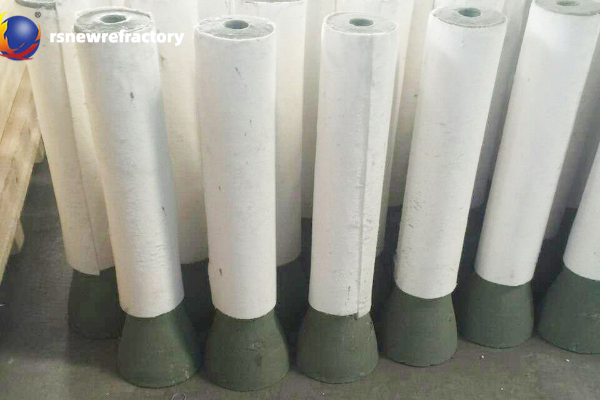
Сопло из плавленого кварца
Изделия из плавленого кварца обладают хорошими свойствами.: небольшой коэффициент теплового расширения, и хорошая стабильность объема; из-за небольшого коэффициента теплового расширения, он имеет хорошую устойчивость к высокотемпературному термическому удару; хорошая химическая стабильность, и хорошая кислотостойкость, за исключением плавиковой кислоты и концентрированной фосфорной кислоты при температуре выше 300 ℃., у него химическая эрозия, и практически не реагирует с другими кислотами; устойчивость к эрозии; высокая температура - высокая вязкость, 105Па·с (106 уравновешенность) при 2000 ℃, и может достигать 5×10⁸Па·с при 1550℃.; высокая прочность, плохая теплопроводность, почти не меняется при температуре ниже 1100 ℃; низкая проводимость. Однако, при длительном использовании при высоких температурах, произойдет кристаллическая трансформация, и кварц выпадет в осадок, что приводит к трещинам и отслаиванию насадки. Кроме того, так как сопло из плавленого кварца может реагировать с марганцем в стали, он не может отливать сталь с высоким содержанием марганца, и может отливать только обычную углеродистую сталь и сталь с низким содержанием марганца..
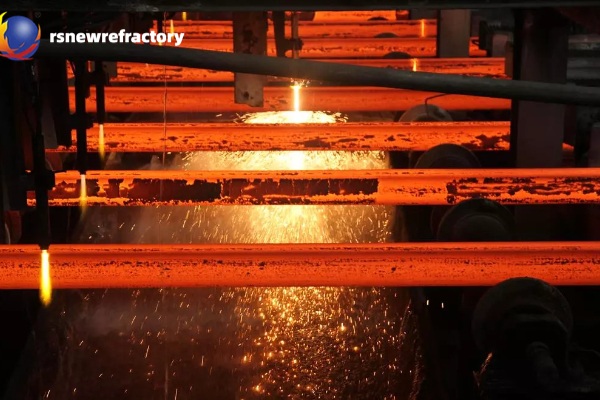
Погружное сопло из алюминия и углерода
В алюминиево-углеродных форсунках обычно используется композит, состоящий из оксида алюминия., плавленый кварц, и графит. Материал алюминиево-углеродного сопла оксида алюминия обычно представляет собой плавленый или спеченный оксид алюминия., синтетический муллит, и другое синтетическое сырье, а графит представляет собой чешуйчатый графит с чистотой более 99%. Алюмоуглеродные погружные сопла состоят из вышеуказанного сырья., а затем изостатическое прессование и обжиг в восстановительной атмосфере. Это композиционные материалы на керамической связке..
По сравнению с форсунками из плавленого кварца, Алюмоуглеродные сопла обладают большей устойчивостью к эрозии расплавленной стали., меньше загрязнения расплавленной стали, небольшие изменения температуры, вызванные длительным использованием, и длительный срок службы. Он может осуществлять непрерывную разливку в нескольких печах и расширять типы стали для непрерывной разливки.. Поэтому, Алюмоуглеродные погружные сопла в течение длительного периода времени были основными соплами кристаллизаторов непрерывной разливки..
Many nozzles currently used are improved on the basis of aluminum carbon nozzles. Однако, there are still some defects in the aluminum carbon nozzle during the continuous casting process: poor resistance to mold slag erosion, плохая стойкость к термическому удару, and poor thermal conductivity, which will cause slag and alumina inclusions to adhere to the nozzle, resulting in nozzle blockage, seriously affecting the smoothness of continuous casting. Кроме того, графит, one of the raw materials, is dissolved and oxidized by molten steel, causing partial damage to the nozzle.
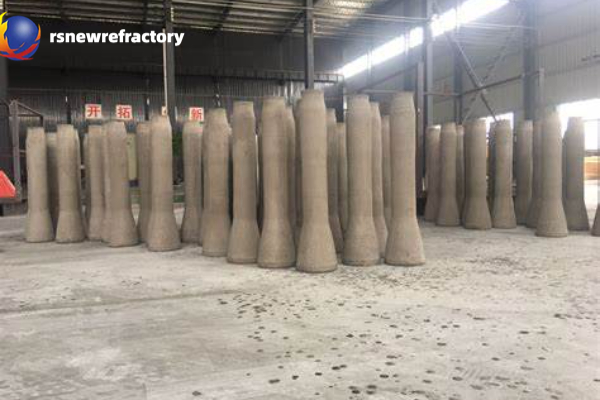
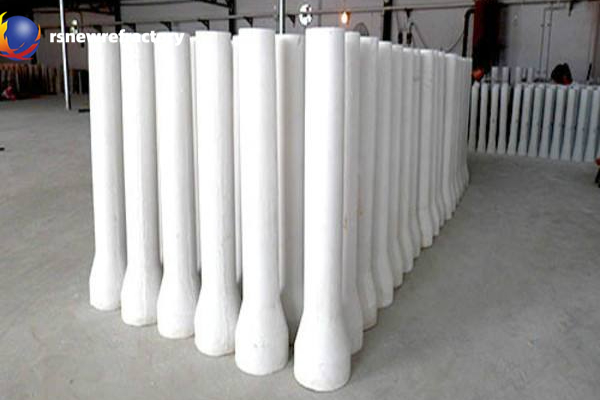
Aluminum carbon-zirconium carbon composite sub entry nozzle
① Aluminum-carbon-zirconium-carbon composite immersion nozzle
With the continuous use of aluminum-carbon nozzles, their disadvantages are gradually exposed in the continuous casting process: the corrosion resistance of aluminum-carbon nozzles is relatively poor, and it is easy to cause local corrosion at the nozzle slag line, forming a “neck shrinkage phenomenon” or even fracture, and it is easy to form Al2O3 and other deposits of molten steel deoxidation products inside the nozzle, causing nozzle blockage, which seriously affects the continuous casting of multiple furnaces. Поэтому, many researchers have continuously studied the material of nozzle refractory materials. On the basis of aluminum-carbon nozzles, aluminum-carbon-zirconium-carbon composite immersion nozzles have been developed, то есть, the main body is mainly made of Al2O3-C material, and the slag line is composited with a layer of ZrO2-C material. Its multi-layer structure is shown in Figure 1. Состав материала цирконийуглеродистого огнеупора в шлаковой линии обычно следующий:: ZrO2 составляет 65%~85%, Стабилизатор CaO составляет 3–8%, стабилизатора Y2O3 приходится около 1%, графит составляет 10%~20%, и есть некоторые добавки. Циркониевый углеродистый огнеупор используется в шлаковой линии, поскольку оксид циркония обладает высокой химической стабильностью и более устойчив к эрозии шлака в кристаллизаторе непрерывной разливки, чем оксид алюминия.. ZrO2, растворенный в шлаке при высоких температурах, увеличивает вязкость литейного шлака.. Кроме того, насыщенная растворимость оксида циркония в шлаке кристаллизатора очень низкая, и только часть его может раствориться в шлаке. Нерастворенные частицы оксида циркония плавают на поверхности жидкого шлака., which increases the apparent viscosity of the mold slag and reduces its fluidity. This inhibits the erosion of the mold slag on the ZrO2-C material in the slag line, improves the corrosion resistance of the nozzle, and extends the service life of the submerged nozzle.
②The properties of ZrO2 in the slag line
Zirconia has relatively stable chemical properties and is not easy to react chemically with other substances. It also has a high melting point (2700℃), high resistivity, Высокий показатель преломления, and very low thermal expansion coefficient. Поэтому, it is often used as a high-temperature refractory material and ceramic insulation material. Zirconia has different crystal structures at different temperatures. There are three main types: monoclinic system (m-ZrO2), tetragonal system (t-ZrO2) and cubic system (c-ZrO2).
When heated to 1170℃, monoclinic (m-ZrO2) will transform into tetragonal (t-ZrO2), accompanied by volume shrinkage. When the temperature drops to 850~1000℃, it will transform from tetragonal (t-ZrO2) to monoclinic (m-ZrO2), and volume expansion will occur, accompanied by a volume change of about 3%~5%.
As the refractory material for the slag line of the submerged nozzle, pure zirconium oxide is not used directly but needs to be stabilized before it can be used as a nozzle refractory. Однако, the thermal expansion coefficient of completely stabilized ZrO2 is large, which will reduce the thermal shock resistance of the submerged nozzle, while the thermal shock stability of the nozzle can be improved by the small expansion coefficient of partially stabilized ZrO2. Поэтому, partially stabilized ZrO2 (PSE) is usually used in the slag line.
Common stabilizers for zirconium oxide include CaO, MgO, Y2O3, и т. д.. The solid solutions formed by these stabilizers and zirconium oxide have different stability. Среди них, the solid solution formed by Y2O3 and zirconium oxide will not decompose when heated for a long time at high temperature, while the solid solution formed by MgO and zirconium oxide has the worst stability, and decomposition reaction will occur when heated at high temperature for a long time;
For the solid solution formed by CaO and zirconium oxide, partial decomposition will occur when heated at a high temperature for a long time. Поэтому, in terms of the stability of the solid solution formed after the zirconium oxide is stabilized, Y2O3 has the best effect, but its resources are relatively scarce and expensive.
Поэтому, CaO is generally selected as a stabilizer. Кроме того, due to the uneven distribution of zirconium and calcium elements in the stabilized zirconium oxide, the stabilizer CaO will produce desolvation, resulting in the instability of the stabilized zirconium oxide and its corrosion resistance will be reduced. In the zirconium oxide stabilized by Y2O3, the distribution of zirconium and yttrium in the solid solution is very uniform, and it is not easy to produce instability. Поэтому, a small amount of yttrium trioxide is usually added to the calcium-stabilized zirconia, and the amount of calcium oxide added is usually around 3%~8%, and the content of Y2O3 is usually around 1%.
WeChat
Отсканируйте QR-код с помощью wechat